ClaimScope field guides
FIELD GUIDE
C&P Exam Prep
What the examiner is scoring, how to describe a bad day without exaggerating, and what to do the week after.
A chapter for your exam:
- PTSD and mental health · p. 9
- Tinnitus and hearing loss · p. 12
- Sleep apnea · p. 14
- Migraines · p. 15
- Joints and back · p. 17
- Hypertension · p. 19
Written by Gabe, a VA-accredited attorney and Afghanistan infantry Veteran.
Free, with the other three guides
A 31-page PDF. Leave your email and we'll send a download link for all four guides and the Claim Organizer Kit, yours to keep.
Look inside: 31 pages
These are real pages from the PDF you download, not mockups. Select a page to read it full size.
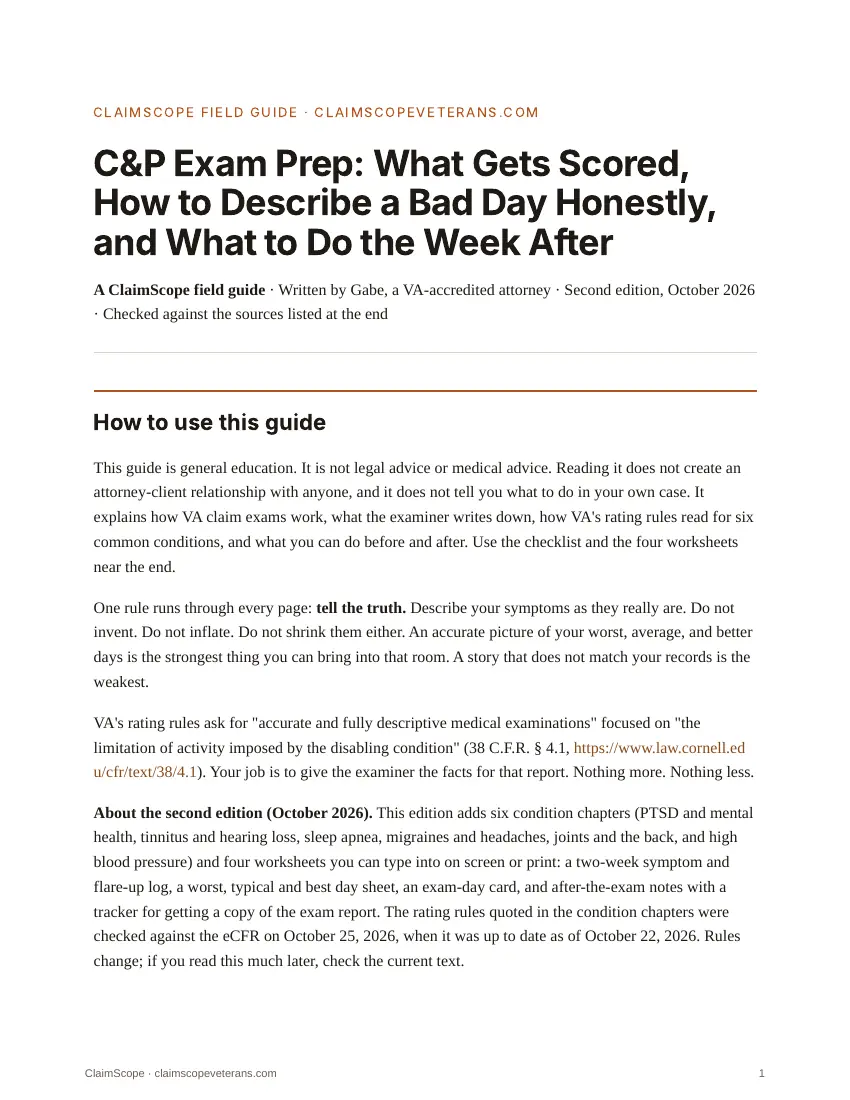 (opens the full-size page in a new tab)
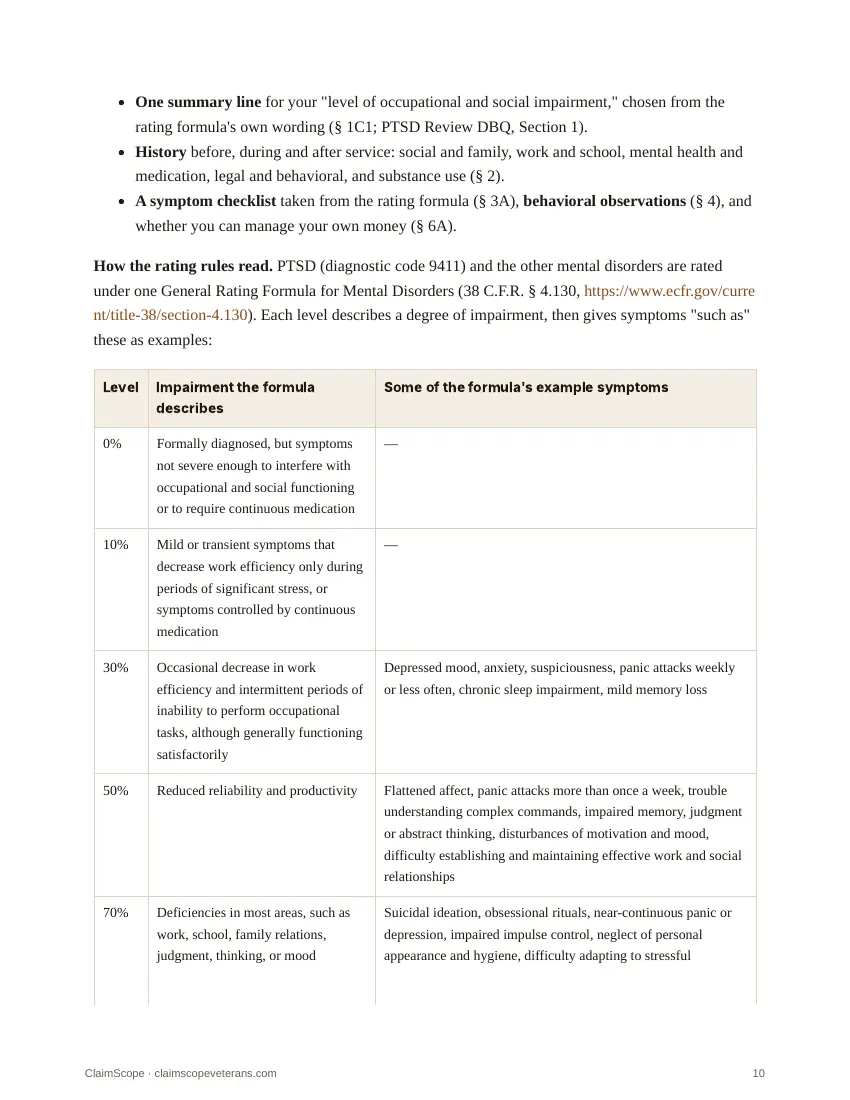 (opens the full-size page in a new tab)
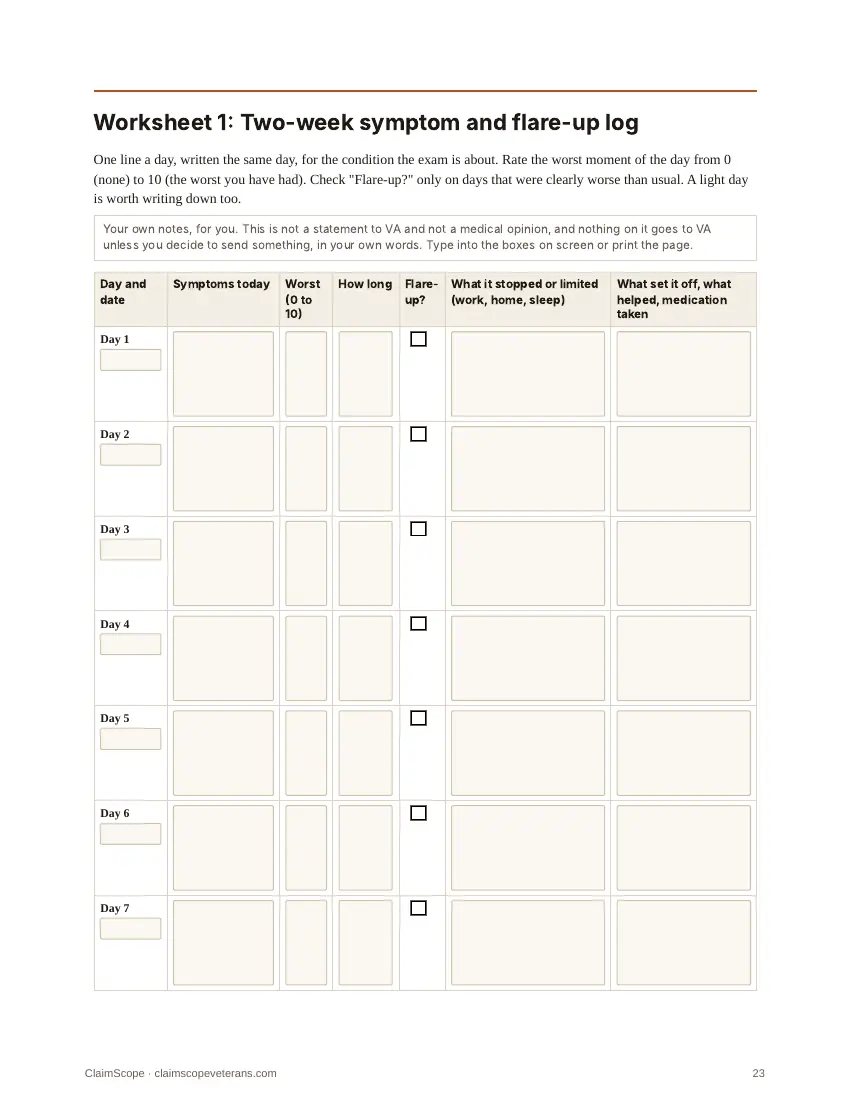 (opens the full-size page in a new tab)
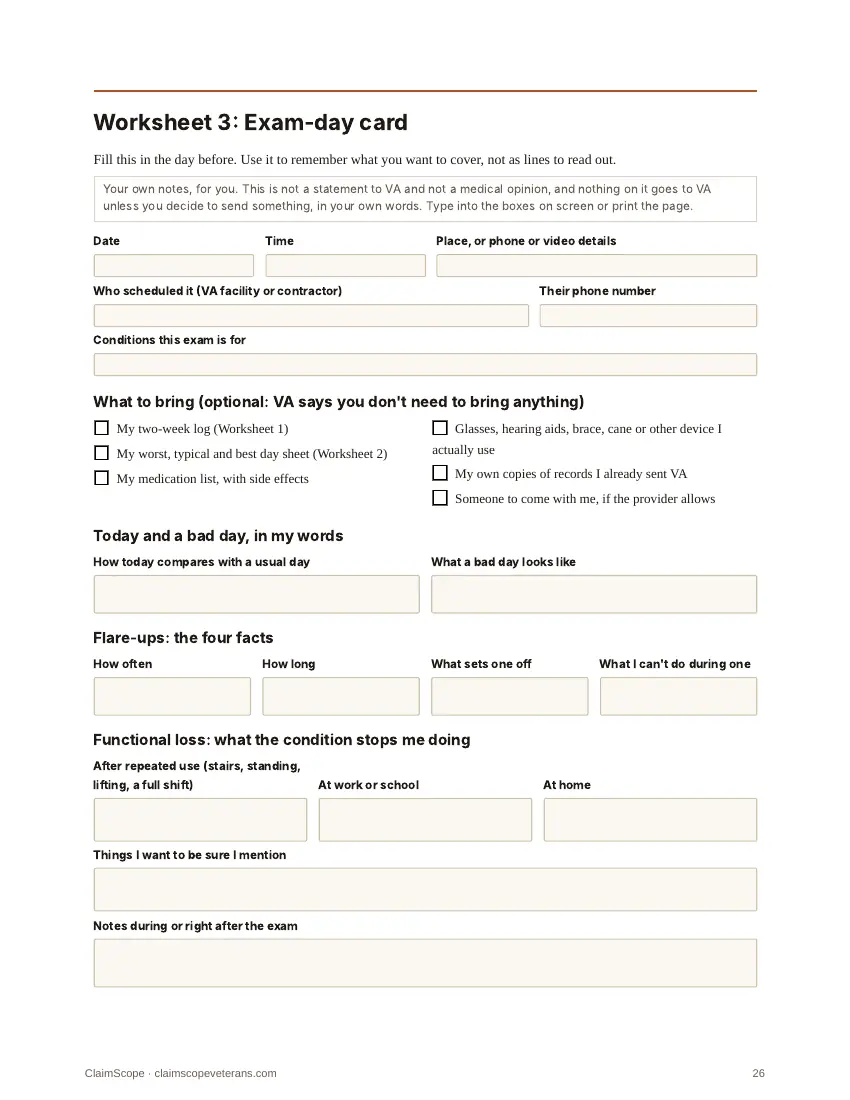 (opens the full-size page in a new tab)
Contents of C&P Exam Prep
Every section in the guide, with the page it starts on. 31 pages in all.
- How to use this guidepage 1 of 31
- What a C&P exam is and isn'tpage 2 of 31
- How a DBQ turns your words into a ratingpage 3 of 31
- Before the exam: a one-week prep planpage 4 of 31
- At the exam: describing a bad day honestlypage 6 of 31
- After the exam: the week afterpage 7 of 31
- Reading the condition chapterspage 9 of 31
- PTSD and mental health examspage 9 of 31
- Tinnitus and hearing loss examspage 12 of 31
- Sleep apnea examspage 14 of 31
- Migraine and headache examspage 15 of 31
- Joint and back exams: range of motion, flare-ups and functional losspage 17 of 31
- Hypertension examspage 19 of 31
- Checklistpage 21 of 31
- Worksheet 1: Two-week symptom and flare-up logpage 23 of 31
- Worksheet 2: Worst, typical and best daypage 25 of 31
- Worksheet 3: Exam-day cardpage 26 of 31
- Worksheet 4: After-the-exam notes and the exam reportpage 27 of 31
- When to get a person involvedpage 28 of 31
- Sourcespage 28 of 31
What it covers
- How DBQs turn your words into a rating
- Flare-ups, functional loss and the questions that matter
- Chapters on six common exams: PTSD and mental health, tinnitus and hearing loss, sleep apnea, migraines, joints and back, and hypertension, with how VA's rating rules read for each
- Four fillable worksheets: a two-week symptom and flare-up log, a worst, typical and best day sheet, an exam-day card, and after-the-exam notes
- Bringing a witness, taking notes, requesting the report
- What to do when the exam went wrong
What this guide is
This is general education about the VA claims process, written for any Veteran. You don't upload anything to get or read it. It isn't legal advice or representation. The tools that work with your own claim, like the deadline check and the free decision check, are free.
Read a free sample →Have your VA decision letter in hand?
Run the free decision check first: your issues and deadlines. Sitting with your paper letter on a phone? Take photos of each page (up to 25), or email yourself a link to upload a PDF from your computer.
Check my decision freeThe free decision check is separate from the guides.
Guides are general education, not legal advice. See every guide.